<< Return to main page
Here's a list of old episodes in date order! There have been some great conversations so feel
free to binge them all!
Filter by popular collections:
CPO Stories | Top Episodes | Influencers | Authors | Product Discovery | Product Design | Product Marketing | Product Leadership | Diversity & Inclusion | Product Ethics | Hot Takes | All Episodes
CPO Stories | Top Episodes | Influencers | Authors | Product Discovery | Product Design | Product Marketing | Product Leadership | Diversity & Inclusion | Product Ethics | Hot Takes | All Episodes
<< Back to main page

Episode 78 - How to Deploy Empathy to Truly Understand User Needs (with Michele Hansen, Author “Deploy Empathy“)
Authors
Product Discovery
Startups
User Research
Episode 78: How to Deploy Empathy to Truly Understand User Needs
Michele Hansen, Author "Deploy Empathy"1 Sep 2021
1 Sep 2021



About the Episode
An interview with Michele Hansen. Michele is the founder of Geocodio, a startup she founded without taking external funding. She is also the author of "Deploy Empathy", a book that aims to help product teams & founders to get better at user research & get the insights they need.
We speak about a lot, including:
- Why now was the time for a new book on customer interviewing skills, how it's different to other books on discovery
- How the book has gone down, some of the feedback that she's gotten so far, and how she knew it had done the job she wanted it to
- How to introduce customer research into companies which aren't currently up for it & sell the idea to leadership
- Whether the techniques in the book constitute manipulation and whether she's worried they could be used for evil
- Whether the book teaches you to be truly empathetic or is a guide to fake it till you make it, and whether this matters
- How you don't need users to have empathy with you, and have to channel your inner rubber duck to make sure they open up to you
- The importance of validating not just hypotheses but also validating your users by resisting the urge to correct their mistakes
- Why you shouldn't use customer discovery interviews to try to sneak in sales or directly try to stop people churning
And much more!
Buy Deploy Empathy
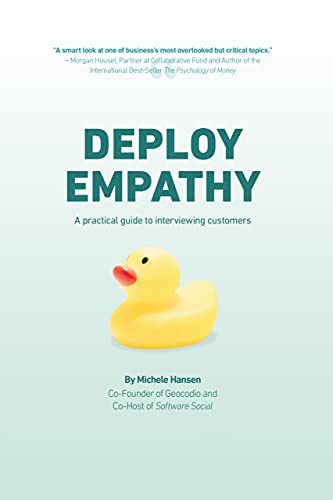
"Deploy Empathy will help you learn the skill of talking to your customers—learning to truly listen to them—so that you can pull out their hidden needs, desires, and processes.
Empathy is a skill that anyone can learn. Armed with the tactics you’ll learn in this book and the toolbox of scripts and phrases, you'll be able to sell more of your existing product, build the right features that will delight your customers, and stop churn in its tracks."
Visit the book website or check it out on Amazon or Goodreads.
Contact Michele
You can contact Michele on Twitter or check out deployempathy.com.
Related episodes you should like:
- Let's Get Real About Synthetic Users (Hugo Alves, Co-founder @ Synthetic Users)
- Building the Future of Professional Networking (Peter Johnston & Matt Breuer, Founder / Product Director @ Polywork)
- Chinese Startup Culture & Putting the Minimum into MVP (Carlos Lastres, Creative & Marketing Director @ Kaiyan Medical)
- Victoria Sakal's Hot Take - You're Either Paying the Research Tax or the Stupid Tax (Victoria Sakal, Growth, Strategy & Research Leader)
- Product Leadership Principles for Tumultuous Times (Giff Constable, Author "Talking with Humans" & "Testing with Humans")
- Making Sure You Make an Impact through User Research (Steve Portigal, User Research Consultant & Author "Interviewing Users")
- Getting into the Habit of Continuous Discovery (Teresa Torres, Author "Continuous Discovery Habits")
- Standing up for User Research... and User Researchers (Debbie Levitt, CXO @ DeltaCX and Author "Customers Know You Suck")